Best AI Agents 2026: 7 Tools Automating Workflows Fast
- April 24, 2026
- 0

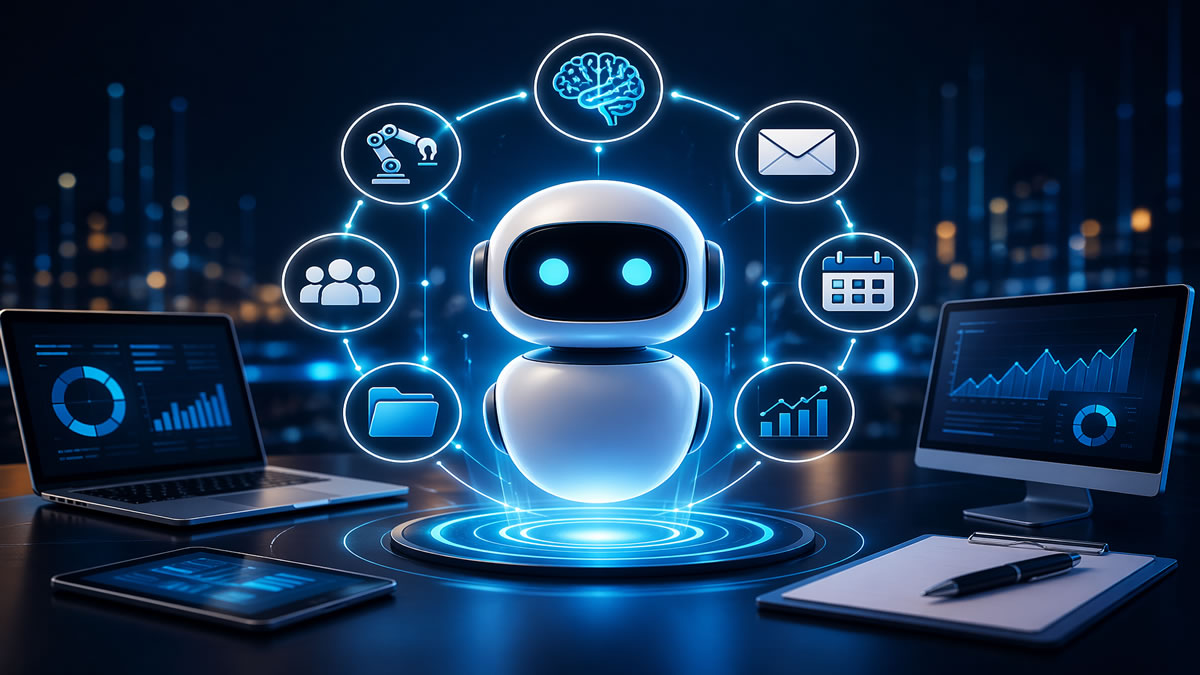
The tension in modern USA offices is visible; teams are drowning in work about work while trying to stay ahead of 2026 market speeds. You likely feel the weight of endless manual data transfers, unorganized lead routing, and repetitive scheduling that eats 40% of your day. Finding the best AI agents to automate workflows in 2026 is the only way to break this cycle and shift your team toward a high-value strategy.
The era of simple chatbots is over, replaced by autonomous entities that plan and execute complex goals. To understand how these tools are fueling new ventures, check our business category or explore the latest online business ideas. Strategic firms are already using the controversial strategy behind fusion IPOs to fund agent-first operations that scale without adding headcount.
In 2026, the gap between simple automation and autonomous AI agents has become a chasm. Legacy tools require rigid logic that breaks the moment an email has a typo or a field is missing. Modern AI agents’ workflows use advanced reasoning to solve these problems without human intervention. Recent data from Gartner suggests that 40% of enterprise applications now feature task-specific agents.
These tools function as digital employees rather than simple scripts. They utilize an AI agent’s architecture that allows them to browse the web, use software interfaces, and communicate with other agents. This evolution is exactly why organizers think they got creamed by Amazon; the retail giant was an early adopter of agentic logic.
The limitation here is agent drift, where an agent might deviate from company policy over hundreds of executions. This requires a strong human-in-the-loop oversight system to maintain brand consistency. Without periodic audits, autonomous agents can prioritize speed over accuracy in high-stakes environments.
To move from theory to high-performance execution, you must deploy the right platforms for your specific needs. Here are the 2026 leaders in AI workflow automation tools that are currently delivering measurable ROI for USA businesses.
The drawback to this variety is tool sprawl. Managing five different agent subscriptions can lead to fragmented data and security risks. Most successful firms are consolidating their AI agents for business into one primary orchestrator to maintain a single source of truth.
The most significant AI market growth this year is coming from multi-agent systems. Instead of one general agent, businesses are deploying specialized agents that coordinate with each other. For example, a customer service agent might pull data, while a billing agent processes the refund, and a supervisor agent verifies the policy.

These autonomous AI agents operate in parallel, which massively increases the velocity of your business operations. According to Reuters, companies using multi-agent architectures report a 35% improvement in task completion rates. This coordinated approach turns your automation into a digital assembly line.
However, the complexity of these systems introduces a cascade risk. If the research agent provides flawed data, every agent down the line will produce incorrect results. This makes grounding your agents in high-quality company data the most critical step in 2026 implementation.
| Feature | Legacy Automation (2024) | Autonomous AI Agents (2026) |
| Logic Type | Fixed (If-This-Then-That) | Dynamic (Reasoning-Based) |
| Data Types | Structured (Sheets/CSV) | Unstructured (Email/Voice/PDF) |
| Error Handling | Stops/Alerts Human | Attempts Self-Correction |
| Execution | Single Task | End-to-End Goal Completion |
| Primary Tool | Basic Zapier / Make | Arahi AI / CrewAI |
To successfully start with workflow automation with AI, avoid the mistake of trying to automate everything at once. Pick one high-friction, repetitive task—such as invoice ingestion or lead enrichment—and deploy a dedicated agent. This allows you to measure the AI agents’ real-world use and calculate ROI before scaling.
The World Economic Forum has highlighted that AI task automation tools are now a core pillar of global productivity. Businesses that integrate intelligent agents AI into their daily stack are seeing a 20-25% reduction in operational costs. This efficiency is what allows small teams to compete with much larger organizations in 2026.
A major limitation is the adoption gap. Your team may feel threatened by agents if they are not trained on how to supervise them. The most successful implementations treat AI agents as interns that require clear instructions and human approval for final outputs.
The best AI agents to automate workflows in 2026 are the ones that move beyond conversation and into direct action. We are moving toward a manager-first workforce where your value is tied to how well you orchestrate your digital team. By selecting the right AI productivity tools in 2026, you can protect your margins and ensure your human talent is spent on the creative work that machines cannot replicate. Start with one core process, use a tool like Arahi or CrewAI, and build your digital workforce one agent at a time.
The leaders in 2026 are Arahi AI for no-code business operations and CrewAI for building complex multi-agent systems. Zapier Central is the top choice for those needing deep integration with existing SaaS stacks.
Look for tools that offer high reasoning capabilities and human-in-the-loop features. The best AI agents to automate workflows in 2026 should be able to explain their logic and ask for help when a goal is ambiguous.
Security depends on the platform’s compliance with SOC2 and HIPAA standards. Always ensure your AI task automation tools use enterprise-grade encryption and do not use your private data to train their public models.
Popular examples include autonomous SDRs for sales outreach, automated close-the-books agents in finance, and triage agents that handle 80% of customer support tickets without human intervention.
Yes. Platforms like Arahi AI and Lindy are specifically designed for non-technical founders and managers. They use natural language interfaces to set goals and configure AI agents for real-world use cases.