AI Stocks 2026: Top Picks & Is It Too Late to Invest?
- April 23, 2026
- 0


The anxiety in the brokerage apps of most USA investors is reaching a fever pitch right now. You are likely watching your portfolio, or the headlines, and wondering if the easy money has already been made. In 2026, AI stocks are no longer a speculative search term; it is a massive structural shift in global capital that is already reshaping the S&P 500. Reuters has reported massive AI spending plans from Microsoft, Amazon, Alphabet, and Meta, while AP has noted that the AI boom is creating sharp market swings that test even the most seasoned traders.
The practical takeaway is simple: if a company is not showing real-world execution, the market is starting to punish the hype. However, the spending spree is far from over. If you want to understand how this tech shift impacts your career, connect this piece with our AI jobs 2026 guide. For a broader context on the economy, visit our business hub to see how the strategy behind fusion IPOs is fueling this capital blitz.
The main reason AI stocks remain strong is simple: the capital expenditure is enormous and still expanding. Reuters reported that Alphabet, Amazon, Meta, and Microsoft are gearing up for a capital expenditure blitz, with plans to spend about $650 billion on data centers and chips as the race intensifies. Amazon alone is targeting nearly $200 billion in spend, reflecting a “winner-takes-most” market belief that exceeds the GDP of many mid-sized nations.
This matters because AI market growth is no longer just a software dream. It is a massive physical build-out. Strong forecasts from manufacturers like ASML and TSMC suggest the build-out cycle remains intact because hyperscalers need more compute power than currently exists. Companies are building data centers at a scale never seen this century, turning digital growth into a construction and hardware boom.
The limitation here is that massive spending does not automatically equal immediate profit. A company can pour billions into infrastructure and still disappoint shareholders if the resulting revenue lags behind the cost of debt. We are also seeing a “power wall” as data centers become increasingly energy-intensive, forcing some projects to be delayed due to local grid constraints.
For the most famous names, it may be too late to expect the 10x returns early buyers enjoyed. However, for the broader theme, the answer is no. Reuters noted that while 28 stocks drove the first wave of the AI era, the investment theme has widened. The IMF’s 2026 report suggests that while AI-related skills are commanding premiums, the structural economic shift is only beginning to reflect in corporate productivity.
Many investors assume the answer is only found in a few giant names. In reality, the second wave of investment often shows up in the companies selling the “picks and shovels.” For example, networking firms like Nokia have reported a surge in AI and cloud orders, with optical network demand growing 49% in early 2026. These are the companies that enable the AI giants to function, and they often trade at more reasonable valuations.
The limitation to this expansion is volatility. AP News has reported that the AI boom has caused the largest swings in U.S. technology stocks since the pandemic. When a theme becomes this popular, the path to profit gets much rougher. A single missed quarterly forecast can now trigger a double-digit percentage drop in a single trading session.
AI market growth in 2026 is a layered tech stack. At the top are the platform leaders. These are the firms building the massive models. They benefit from huge user bases and the ability to fund the $650 billion capex mentioned earlier. They are the primary spenders keeping the entire ecosystem alive through sheer financial force.
Below that are the infrastructure names. These include chipmakers, optical transport companies, and cooling vendors. These suppliers often get paid first because the hardware must exist before the software can run. The AI build-out is currently supporting record demand for connectivity and thermal management solutions for dense server racks that generate massive heat.
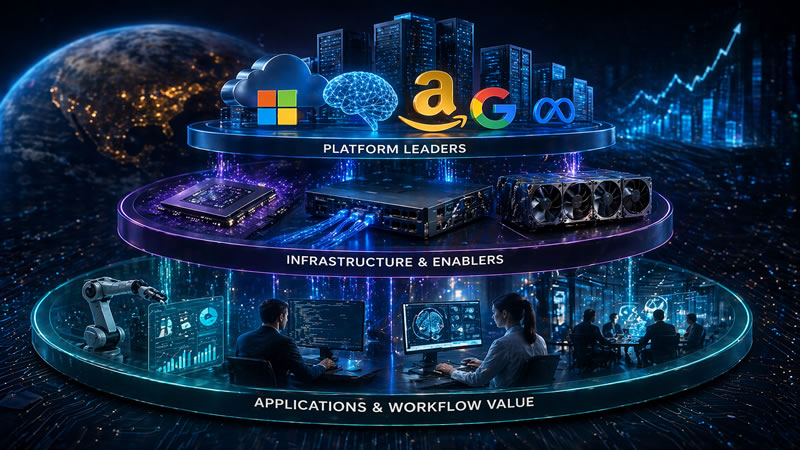
At the application layer, the companies are turning AI into actual workflow value. These are the businesses showing higher productivity and lower operational costs. According to the IMF, AI is already a structural shift in the global economy. This is where the long-term investment case stays interesting as businesses integrate AI into daily operations to protect their margins from inflation.
The limitation here is timing. Infrastructure usually sees the money first, while applications can take years to prove they can generate recurring revenue. Investors who expect every company with an AI label to show immediate profit usually end up disappointed by the lag in corporate adoption.
| Segment | 2026 Risk Level | Growth Driver | Primary Constraint |
| Hyperscale Cloud | Medium | $650B Capex | Revenue Margin Pressure |
| Semiconductors | Medium | Hybrid Bonding Tech | Supply Chain Lead Times |
| Optical Networking | Low | Data Center Interconnect | Skilled Labor Shortage |
| Grid Energy | High | 31x Power Demand Surge | Infrastructure Bottlenecks |
| Enterprise SaaS | High | Workflow Automation | Corporate Adoption Lag |
The best AI stocks are usually not the ones with the loudest social media presence. They are the ones with real customers and sustainable cash flow. You should look for companies that can explain exactly how AI improves their numbers, whether through higher margins or faster deployment.
A better way to think about the trade is by layers. At the core is computing power. But as compute scales, the bottleneck moves to power and connectivity. Companies that own the “on-ramps” to the data center, the fiber optics, the electrical transformers, and the specialized cooling are becoming the new defensive plays in a high-growth sector.
The limitation is that not every company with a slick pitch deck will benefit. Many will overpromise and underdeliver. This is why AI investment must be tied to measurable execution rather than slogans. If the “how” and “why” of their AI revenue is not clear in their SEC filings, it is likely just marketing noise.
AI stocks remain a massive opportunity in 2026, but the story has moved past the simple excitement phase. The current wave is about the physical reality of the build-out: the chips, the power, the cooling, and the software that actually improves the bottom line. Recent data from Reuters, the IMF, and the WEF all suggest that while the build-out is active, the market is more selective than ever before.
Success in this market requires moving before the crowd does. The winners are those who look beneath the surface of the news to find the real drivers of change.
Select names are definitely expensive relative to their current earnings. This does not mean the entire AI stocks theme is finished, but it does mean investors must be more selective and look for value in the infrastructure and application layers.
Focus on the leaders in chip manufacturing equipment, optical networking, and enterprise software integration. Look for companies that have a clear path to turning AI into a recurring revenue stream rather than a one-time project.
Hardware and infrastructure generally get paid first during the build-out phase. Software and applications usually provide longer-term value once businesses have fully integrated the technology into their workflows.
The biggest risks include energy shortages, regulatory crackdowns, and a potential valuation bubble if companies cannot prove that their massive investments are creating enough profit to justify their stock prices.
Maintain a long-term horizon and avoid putting all your capital into a single day’s hot ticker. Use a layered approach that gives you exposure to different parts of the tech ecosystem rather than just the most famous brands.