Rohit Sharma Injury: Latest Update Before MI vs PBKS
- January 29, 2024
- 0

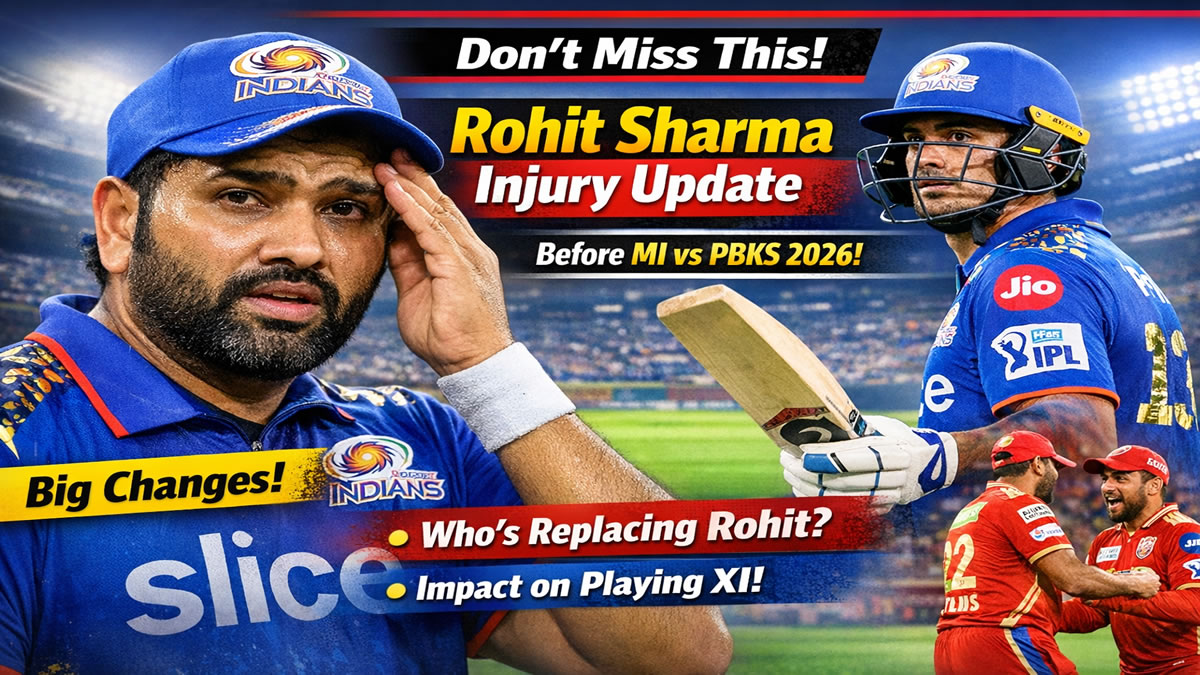
Most people wait until the toss and then rush to search. That is the mistake. The Rohit Sharma Injury Update already changed the story before the first ball. If you follow the IPL closely, you know one fitness doubt can flip the whole match preview. And right now, the Rohit Sharma Injury Update is the biggest reason MI vs PBKS 2026 suddenly feels different. Fans want to know if Rohit is in, who replaces him, and what this means for Mumbai Indians’ top order. The Rohit Sharma Injury Update is not just a team note. It is the headline that changes the whole conversation.
The Rohit Sharma Injury Update matters because Mumbai Indians were already under pressure before this game. Reports say Rohit picked up a hamstring injury in the previous match against Royal Challengers Bengaluru, missed training, and then missed out against Punjab Kings. Hardik Pandya said the team would assess him over the next couple of games, which shows MI treated this as more than a minor niggle.
What makes this a real search topic is simple. Fans do not just want a score update. They want to know whether MI must reshuffle the opening plan, who steps in, and whether the batting order changes. A business example is a sports site that publishes one sharp injury-led preview before the toss. That article can beat a generic match preview because it answers the most urgent question first. The limitation is timing. If the injury status changes and the page is not refreshed, the article goes stale fast.
The latest reporting says Rohit had a suspected hamstring issue after being forced to retire hurt against RCB. TOI reported scans were taken to assess the injury, and later updates said he was still heavily strapped and looked uncomfortable in practice. HT and Tribune both described his role against PBKS as doubtful or unavailable. ESPN also reported he missed out with what looked like a hamstring injury.
What this means in plain language is that the decision was not about form alone. It was about fitness and risk. That is why the Rohit Sharma Injury Update matters so much for both fans and writers. If a player like Rohit is even slightly compromised, the team has to decide whether to protect him or force a risky return. The limitation is that the medical detail is still not fully public, so the safest wording is “suspected hamstring issue” rather than pretending the exact severity is known.
The mi vs pbks playing 11 changed once Rohit was ruled out. ESPN reported that Mumbai Indians brought back Quinton de Kock, while Rohit missed out and Mitchell Santner was also unavailable because of illness. MI replaced Santner with debutant offspin allrounder Mayank Rawat. ESPNcricinfo’s match preview and live report showed MI were forced to rework their balance rather than make one simple swap.
This is exactly why the Rohit Sharma Injury Update affects more than one spot. When the opener is missing, the top order changes. When Santner is unavailable, the overseas and bowling balance changes too. MI’s final XI, as reported by ESPN, included Quinton de Kock, Ryan Rickelton, Tilak Varma, Suryakumar Yadav, Hardik Pandya, Sherfane Rutherford, Naman Dhir, Mayank Rawat, Shardul Thakur, Deepak Chahar and Jasprit Bumrah.
A project example that works well for content teams is this: publish a “confirmed XI” box beside the injury update. That keeps the article useful after the toss and gives the reader a quick answer in one glance. The limitation is that confirmed XIs can make earlier prediction paragraphs look wrong if you do not update them quickly.
The most obvious replacement move was Quinton de Kock returning to the top. ESPN’s live update described him as the old faithful brought back in because Rohit was out. That choice tells you MI preferred experience and stability over experimentation. It also suggests the team wanted a proven opener to absorb the powerplay pressure.
That is the practical impact of the Rohit Sharma Injury Update. It changes the identity of the innings. Instead of building around Rohit’s usual top-order role, MI had to lean on de Kock, Rickelton and the middle order. The limitation is that replacement logic can look obvious after the team sheet is released. Before the toss, though, it is a genuine pre-match angle that fans click on fast.
On the other side, Punjab Kings kept things steady. ESPN reported that PBKS chose to bowl first at Wankhede, describing the venue as chase-friendly. The same report noted PBKS stuck with their successful combination and that a win would take them to the top of the points table. That tells you they entered the game with more continuity than MI.
That is where the pbks vs mi match prediction becomes interesting. If MI are missing a senior opener and another key all-round option, Punjab’s decision to bowl first makes tactical sense. It puts pressure on MI to set a target without their normal balance. A realistic match read is that PBKS held the cleaner team shape on paper, while MI had the bigger uncertainty story. The limitation is obvious: prediction is always less reliable when injury news is still moving.
The mumbai indians opening batsman question mattered because Rohit’s role is not just symbolic. He helps settle the innings and gives MI a familiar starting shape. Once he was out, the whole top order had to reset. That is why the match preview became more about replacement and less about routine.
A real-world example: if you run a cricket newsletter, you can turn this into a “what changed in the XI” explainer. Readers love quick clarity during live games. The limitation is that a lineup explainer without injury context feels flat. The Rohit Sharma Injury Update is the hook that makes the whole piece work.
The ipl match preview mi vs pbks was always going to be important, but the injury made it much bigger. ESPNcricinfo’s preview framed MI as a side trying to find the right combination, while PBKS arrived unbeaten. With Rohit unavailable and Santner out, MI’s flexibility dropped and their reliance on middle-order stability increased.
What makes this useful for readers is that it answers the real match-day question: what changed? The answer is the opening structure, the overseas balance and the pressure on Hardik’s batting and tactical choices. The limitation is that pre-match previews age fast. Once the first innings begins, the live game narrative can replace the preview story in minutes.
First, check the injury line before any fantasy or prediction call. If the Rohit Sharma Injury Update says “doubtful,” treat the opener slot as unstable. Second, check the confirmed XI at toss time. Third, look at who replaces him. In this case, de Kock was the key top-order solution and Mayank Rawat came in for Santner. That sequence tells you how MI were thinking.
If you are creating content, the cleanest format is:
That keeps the article easy to scan. A personal test that works well is comparing a headline with and without the player name. Usually the version with the player name gets more clicks because it feels specific and urgent. The limitation is that click appeal only works if the body delivers the same clarity.
The Rohit Sharma Injury Update fits a bigger 2026 trend. Sports audiences now want fast, highly specific updates, not long wait-and-see articles. Players, lineups and match situations are being discussed across search, social and live score channels at the same time. Deloitte’s 2026 outlook says sports continue to converge with media and entertainment, which is why injury news, team updates and match previews travel so quickly now.
A business example is a site that publishes one injury-led preview and then branches into team news, replacement analysis and live match coverage. That structure can attract fast clicks because it matches the way fans search during match windows. The limitation is freshness. If the page is not updated once the XI is confirmed, it loses momentum quickly.
The Rohit Sharma Injury Update is the story that shifted MI vs PBKS 2026 from a normal league match into a true pre-match talking point. It affects the playing 11, the opening strategy and the entire feel of the game. The Rohit Sharma Injury Update also shows why match-day content works so well right now. Fans want the answer fast, then they want the reasoning, then they want the replacement and prediction angle. If you are following the match as a reader, the key is simple: check the injury status, check the XI and then read the tactical impact. If you are creating content, the key is to lead with the injury, then explain the team news, then close with the match outlook. That is how you keep the page useful and clickable at the same time.
Explore the TrendiFlux Blog for expert insights on AI, Tech, and 3D Art. Stay updated with the latest in Business, Design, and Lifestyle through our in-depth guides.
The latest reports say Rohit was dealing with a hamstring issue, underwent scans, and was later ruled out of MI vs PBKS. ESPN and TOI both reported he missed out on match day.
Reports indicate he had a hamstring injury after the previous match against RCB. The team decided to assess him and then left him out when the PBKS game arrived.
ESPN reported that Quinton de Kock returned and filled the opening role when Rohit missed out. That was the main top-order replacement move.
Yes. ESPN reported Santner was unavailable because of illness, and MI replaced him with debutant offspinner Mayank Rawat.
Yes, if the article is written quickly, stays focused and includes the confirmed XI, replacement angle and match preview. Injury-led cricket updates usually perform best when they answer the main question first.