

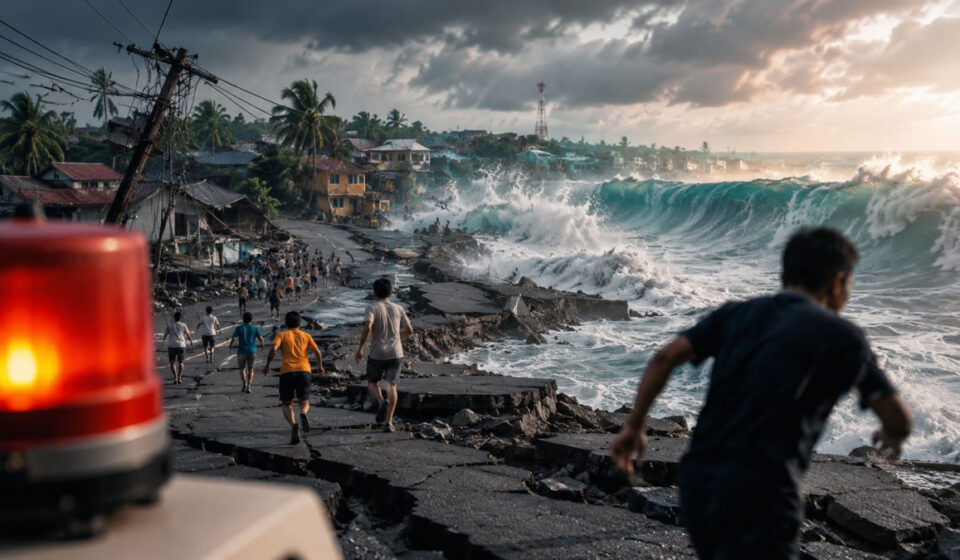
Philippines Earthquake 2026 Triggers Deadly Tsunami Warning
The Philippines earthquake 2026 struck at 7:37 a.m. on Monday, June 8, when a magnitude 7.8 rupture hit offshore Sarangani province – and within minutes, PHIVOLCS issued a tsunami warning for coastal communities across at least nine provinces of Mindanao. This is not a drill. If you or someone you know is in a coastal zone in southern Mindanao right now, stop reading and move inland or to high ground immediately. The technical breakdown below is for everyone outside the immediate danger zone who needs accurate, verified information fast.
| Confirmed Facts | Current Internet Buzz | Hype vs Reality | Consumer Risk Level |
| M7.8 confirmed by PHIVOLCS and USGS; epicenter off Sarangani coast; buildings collapsed in General Santos; tsunami warning active for 9 provinces | Social media posts claiming magnitudes as high as 9.0; unverified casualty numbers circulating widely | Initial PHIVOLCS reading was M7.0 – later upgraded to 7.8. USGS also confirms 7.8. BMKG (Indonesia) estimated 8.2. GFZ (Germany) estimated 8.1. Official Philippines and US figures are M7.8. | CRITICAL for coastal Mindanao residents – MODERATE for inland areas – LOW for Manila and Luzon |
What Happened – The June 8 Rupture Explained
The earthquake was the strongest to hit the Philippines since 1990. Its epicenter was off the coast of Sarangani province in the Soccsksargen region, approximately 26 kilometers west-southwest of Kablalan.
General Santos City – a coastal commercial hub of more than 700,000 people known nationally for its tuna processing industry – took the direct hit. Power was knocked out across parts of the city, and at least one building collapse was confirmed in the initial hours.
PHIVOLCS initially reported the quake at M7.0 before revising upward to 7.8. Aftershocks and damage were expected, and PHIVOLCS warned that tsunami wave heights of more than one meter above normal tide levels were probable.
Philippine President Ferdinand Marcos Jr. issued an immediate national directive. Marcos stated that emergency agencies had been activated – including the Office of Civil Defense and the NDRRMC – and urged citizens directly: “Move to higher ground now. Do not wait. Your life is more important than anything left behind.” Schools across several Mindanao provinces were also ordered closed for the day.
Seismological Profile – Why the Numbers Conflict Between Agencies
This is one of the most misunderstood moments during any major earthquake. Social media explodes with different magnitude figures and readers assume someone is lying. Nobody is. Here is the technical reality.
PHIVOLCS and USGS both confirmed M7.8 at a depth of 55.2 kilometers. The EMSC placed depth at 45 kilometers. Indonesia’s BMKG estimated M8.2 at 46 kilometers depth, while Germany’s GFZ Helmholtz Centre placed the magnitude at 8.1 at 10 kilometers depth.
Why the gap? Every global seismological network uses slightly different seismometer arrays, mathematical models, and depth assumptions. The measurement window immediately after a rupture is narrow and data is incomplete. Shallower depth estimates tend to inflate magnitude calculations. PHIVOLCS and USGS use the most comprehensive regional dataset for Philippine events, which is why their 7.8 figure is the most operationally reliable for response planning.
The USGS measured the original quake at 55 kilometers deep, and aftershocks up to M6.1 followed in the initial hours. Variations in measurements by different agencies are standard in the immediate aftermath of a large earthquake.
One critical data point: on the PHIVOLCS earthquake intensity scale, a maximum intensity of VII – classified as Destructive – was instrumentally recorded at General Santos City. Intensity VII means strong structural movement, furniture thrown violently, plaster falling, and older or weaker buildings experiencing partial or complete collapse.
Marine Threat – The Tsunami Propagation Reality
This is where the stakes become life-or-death for coastal residents.
The Pacific Tsunami Warning Center stated that parts of the Philippine coastline could experience waves up to 3 meters (approximately 10 feet) above normal tide levels, while Indonesian and Malaysian coasts face 1-meter surge risks. PHIVOLCS issued its tsunami warning specifically for Sarangani province, while Indonesia’s BMKG issued separate warnings covering the Maluku Islands, Sulawesi, and Borneo.
The Pacific Tsunami Warning Center’s 7:51 a.m. advisory stated that hazardous tsunami waves were possible within three hours along some coasts of Indonesia, the Philippines, Palau, Taiwan, and Papua New Guinea.
PHIVOLCS confirmed that first tsunami waves were expected to arrive between 7:37 a.m. and 9:37 a.m., and warned that marine surges “may continue for hours.” Residents in coastal areas of at least nine provinces were ordered to evacuate immediately to higher ground. Boat operators in harbors and shallow coastal waters were instructed to secure vessels and move away from the waterfront.
The provinces under immediate PHIVOLCS evacuation orders include: Sarangani, South Cotabato, Sultan Kudarat, Davao Occidental, North Cotabato, Maguindanao del Sur, Maguindanao del Norte, Cotabato City, and Zamboanga del Sur. Verify the current list directly at PHIVOLCS Official Website.
For real-time wave monitoring and the Pacific-wide threat map, track NOAA Pacific Tsunami Warning Center directly.
Structural Damage – What Collapsed in General Santos and Why
A building housing a Jollibee restaurant and a Love Radio studio collapsed in General Santos City, a separate donation center structure also came down, and a high school building in Matanao sustained a collapse.
Video posted on official social media channels showed the three-story Jollibee building going down in a cloud of debris and dust in General Santos, with images also showing smashed windows and caved-in rooftops across multiple structures.
Why did these buildings fail under Intensity VII shaking while others survived? The answer involves a combination of factors that safety engineers study after every major event – soil liquefaction in coastal fill zones, pre-existing structural fatigue, non-compliant construction from earlier decades, and the compounding stress of repeated aftershock sequences. The Matanao High School collapse is particularly significant because it occurred on the first day of the school year, when buildings would have been occupied. Casualty status in the collapsed structures remained unconfirmed in initial reports, with authorities noting it was not yet clear if people were trapped.
This is the danger window that most generic coverage misses entirely – the post-collapse aftershock trap. Structural survivors inside partially damaged buildings face compounding collapse risk with every subsequent tremor. At Intensity VII with M6+ aftershocks confirmed, the indoor duck-and-cover rule that works for moderate earthquakes becomes a liability if the building envelope is already compromised.
YouTube TV 2026 Setup Secrets And Pricing Truths
Deep Geology – The Cotabato Trench and Why Mindanao Never Stops Shaking
Mindanao sits across the complex convergent boundary between the Sunda plate and the Philippine Sea plate. Part of the oblique convergence between these two plates is accommodated by subduction along the Cotabato Trench. The strike-slip component of that convergence is partially handled by the Philippine fault system and partly by the Cotabato Fault System – a network of predominantly northwest-southeast trending sinistral strike-slip faults that form the boundary between the Cotabato Arc and the Central Mindanao Volcanic Belt.
The June 8 rupture was caused by thrust faulting on a north-south striking fault structure – the mechanical signature of a subduction-zone compression event. This is the same tectonic engine that has driven Mindanao’s deadliest historical disasters.
In 1976, a magnitude 8.1 earthquake and tsunami along the same Cotabato Trench system killed 8,000 people – making it one of the deadliest natural disasters in Philippine recorded history. The 2026 event is the strongest rupture from this system in 36 years, and it is operating on the same fault architecture that drove the 1976 catastrophe.
For a full technical breakdown of how subduction zones generate both the largest earthquakes and the most dangerous tsunamis on earth, read USGS Earthquake Hazards Program – the world’s most authoritative public seismology resource.
Understanding this geology is not academic. The Cotabato Trench has accumulated stress for decades between major events. Seismologists monitoring PHIVOLCS official bulletins will be tracking whether aftershock patterns suggest a fault segment fully ruptured or whether residual stress remains locked in adjacent sections.
Safety Directives – How to Evacuate During Active Aftershocks
This is the most under-addressed survival scenario in standard disaster coverage. Most evacuation guidance assumes a single earthquake followed by a clear window for movement. The June 8 event is generating a multi-day aftershock sequence with confirmed tremors up to M6.1. Here is the tactical reality for people in the affected zones.
If you are in a coastal zone with tsunami warning active:
The only correct action is immediate inland movement or vertical elevation to a reinforced high-rise above the third floor. Static sheltering in a single-story coastal structure during an active 3-meter tsunami threat is not a viable safety position – it is a drowning risk. Do not wait for official confirmation of wave arrival before moving. Tsunami arrival time windows are estimates, not guarantees.
If you are moving inland during aftershocks:
- Avoid underpasses, bridges, elevated roadways, and coastal cliffs during movement.
- Move perpendicular to the coastline – inland, not parallel to shore.
- If caught in open ground during a strong aftershock, move away from structures, drop low, and protect your head until shaking stops.
- Do not re-enter any building that showed visible cracking or partial collapse from the main shock.
If power is out and you cannot reach emergency services:
The regional power grid failure documented in General Santos creates a critical communication gap. The only off-grid communication options that function independently of the cellular grid are:
- Battery-powered AM/FM emergency radio – DZRB AM 738 kHz is the official Philippine emergency broadcast station.
- LEO satellite communication devices (Garmin inReach, SPOT) for direct emergency ping to rescue coordination.
- Portable solar-charged power banks to keep smartphones active for emergency text messaging, which uses significantly less bandwidth than voice calls during network congestion.
For extended off-grid preparedness, NDRRMC official emergency guidance maintains the authoritative list of evacuation centers and emergency hotlines by province.
Agency Magnitude Comparison Table
| Agency | Magnitude | Depth |
| PHIVOLCS (Philippines) | Mw 7.8 | 33 km (revised) |
| USGS (United States) | Mww 7.8 | 55.2 km |
| EMSC (Europe) | Mw 7.8 | 45 km |
| BMKG (Indonesia) | Mw 8.2 | 46 km |
| GFZ Helmholtz (Germany) | Mw 8.1 | 10 km |
The operational standard for Philippine disaster response is the PHIVOLCS-USGS consensus figure of M7.8. Higher estimates from BMKG and GFZ reflect different measurement methodologies and depth assumptions, not disagreements about the physical event.
Intensity Scale by Area
| Location | PHIVOLCS Intensity | Classification |
| General Santos City | VII | Destructive |
| Sarangani Province | VII | Destructive |
| Davao City | V | Strong |
| Kidapawan City, Cotabato | V | Strong |
| Mati City, Davao Oriental | IV | Moderately Strong |
| Butuan City | III | Weak |
| Dipolog City | II | Slightly Felt |
What This Means for Mindanao Right Now
The June 8, 2026 earthquake is not a single event – it is the opening phase of a multi-day seismic sequence driven by one of the most mechanically stressed subduction systems in Southeast Asia. The Cotabato Trench has produced M8+ events before and it will again. What the region faces in the coming 72 hours is a compounding emergency: structural damage from the main shock, an active tsunami threat window, a regional power grid failure, and an aftershock sequence with confirmed tremors above M6.
The verified facts are clear. The magnitude is 7.8. The tsunami warning is real. The building collapses in General Santos are confirmed. The casualty picture is still forming, and official figures from the NDRRMC will be updated as rescue teams access affected structures.
For anyone in the affected provinces, follow PHIVOLCS directives without delay. For everyone else – monitor PHIVOLCS official bulletins and NDRRMC situation reports as the only authoritative sources for this event.
Information may change as new official updates become available.
Andreeva Wins French Open 2026 Women’s Title
Frequently Asked Questions
What was the epicenter of the 2026 Philippines earthquake?
The epicenter was off the coast of Sarangani province, approximately 26 kilometers west-southwest of Kablalan and roughly 13 kilometers southwest of General Santos City.
Is Davao City under a tsunami warning?
Davao City recorded Intensity V shaking but was not listed under the primary PHIVOLCS coastal evacuation order. Confirm your area’s current status directly at phivolcs.dost.gov.ph as warnings can be updated rapidly.
Why did different agencies report different magnitudes?
Each global seismological agency uses different sensor networks and depth models. PHIVOLCS and USGS both confirmed M7.8, which is the operational standard for Philippine disaster response. Higher estimates from BMKG and GFZ reflect different calculation methodologies.
How long do tsunami surges continue after the warning is issued?
PHIVOLCS confirmed the first waves were expected within two hours of the 7:37 a.m. rupture and warned that marine surges “may continue for hours.” Coastal areas must remain evacuated until PHIVOLCS officially lifts the warning.
What is the emergency broadcast frequency for Mindanao during the power outage?
DZRB AM 738 kHz is the Philippines’ official government emergency radio station. A battery-powered or hand-crank AM radio is the most reliable communication tool during a regional grid failure.