

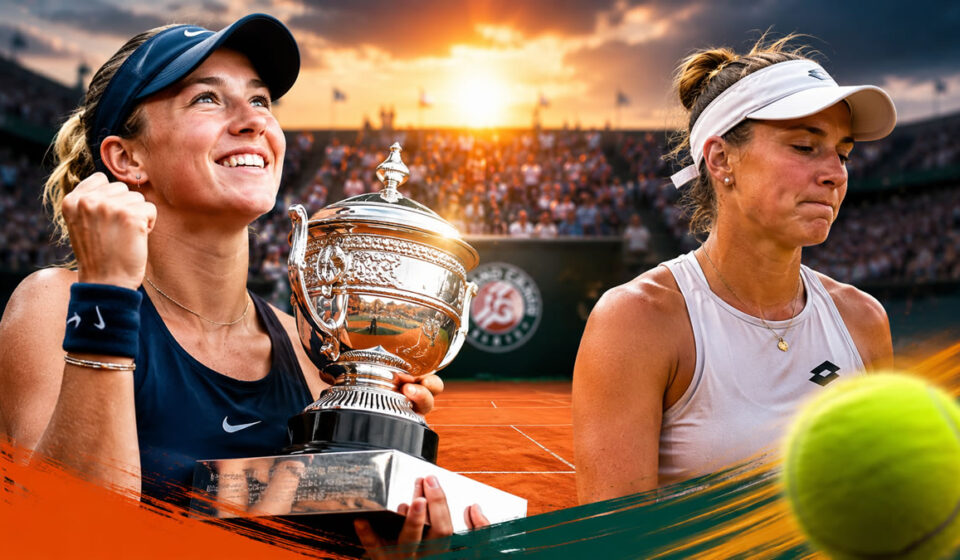
Andreeva Wins French Open 2026 Women’s Title
Mirra Andreeva vs Maja Chwalinska French Open final is over, and the result is official: Mirra Andreeva is the 2026 Roland Garros women’s singles champion, defeating the historic qualifier 6-3, 6-2 in a dominant straight-set performance on Court Philippe Chatrier.
What Happened on Philippe Chatrier
Andreeva controlled this match from the very first game. She broke Chwalinska’s serve repeatedly, converted 7 of 12 break point opportunities across the match, and never allowed the Polish qualifier to settle into any rhythm that could test her.
The first set set the tone immediately. Andreeva moved through it 6-3 with the kind of controlled aggression that made her the clear favorite coming in. The second set was even more decisive. She won nine consecutive games at one point, the longest streak of the entire match, and closed it out 6-2 without ever facing a genuine threat to her serve.
This is Andreeva’s first Grand Slam title. At 19 years old, she becomes the youngest woman to win the French Open since Iga Swiatek claimed the title in 2020 at 19 years and 132 days.
Key Statistics from the Final
| Statistic | Chwalinska | Andreeva |
| Sets Won | 0 | 2 |
| Games Won | 5 | 12 |
| Points Won | 41 | 62 |
| Break Points Won | 3 of 8 | 7 of 12 |
| Unforced Errors | 27 | 24 |
| Winners | 13 | 24 |
| Max Games in a Row | 2 | 9 |
| Max Points in a Row | 6 | 10 |
| Service Points Won | 20 | 28 |
The numbers tell a clean story. Andreeva outproduced Chwalinska in every meaningful category. She won 24 winners to Chwalinska’s 13, and her service dominance was never genuinely threatened across the entire match.
The Turning Point That Decided This Final
The real match was decided in the opening games of the second set. Chwalinska had won three break points during the first set, suggesting she could occasionally disrupt Andreeva’s serve. But once the second set began and Andreeva immediately broke and then held comfortably, the door closed for good.
Chwalinska’s forehand unforced errors were a significant problem. She generated 17 forehand unforced errors compared to Andreeva’s 12, and those mistakes came at the worst possible moments, on break point situations that she could not convert. The numbers underneath the scoreline reveal that Chwalinska fought but could not sustain it.
YouTube TV 2026 Setup Secrets And Pricing Truths
The fatigue factor must also be addressed honestly. Chwalinska had played three qualifying matches before the main draw even began, beating Alice Rame, Carole Monnet, and Suzan Lamens, then won five more main draw matches against ranked opponents. That is nine total matches to Andreeva’s six. By the time this final started, Chwalinska’s legs had already absorbed more clay than any other player in the draw. That is not an excuse. It is a structural disadvantage that was always going to matter in a straight-sets match against a fresher, higher-ranked opponent.
The Prodigy Who Claimed Her Moment
Mirra Andreeva was born on April 29, 2007, in Krasnoyarsk, Russia, and turned professional in 2022. She has been building toward a moment like this for three years on the senior tour, and today it arrived.
Since 1996, only Martina Hingis, Kim Clijsters, and Coco Gauff have been younger women’s singles finalists at Roland Garros. Now Andreeva moves past the finalist stage and takes the title outright.
Entering the 2026 French Open, she had gone 29-9 on the season, winning two singles titles and climbing to No. 8 in the world. She did not lose a set until deep in the tournament, and her clay-court form throughout the fortnight was as clean as any player in the draw, including the seeds who were eliminated before reaching the final weekend.
For official tournament records and her updated ranking, Roland Garros’ official player profile has the full career data.
Chwalinska’s Story Deserves Its Own Chapter
Maja Chwalinska losing a final does not diminish what she accomplished here. Ranked 114th in the world, she became the first qualifier in the professional era to reach a French Open singles final. That is a record that stands regardless of Saturday’s scoreline.
Born in Miechów, 40 kilometers north of Krakow, Chwalinska was a talented junior player who reached the girls’ doubles final of the Australian Open in 2017 alongside Swiatek. But her path to this moment ran through a very dark period.
In 2021, she took an indefinite break from tennis after a first-round defeat in qualifying at Wimbledon, revealing that she had suffered from depression. Then aged 19, she associated tennis with pressure, stress, and crying, and did not know if she would ever return to the sport.
She sought help from mental health specialists back home and described herself at her lowest point as feeling lifeless. After four months away, she returned with a genuinely different relationship to the game. She said afterward that the results no longer defined her the way they once did, explaining that she had been unable to separate herself from the tennis player identity, and that she needed time to figure out who she was beyond the sport.
That shift in mindset is what put her in a Grand Slam final at 24. The scoreline on Saturday does not erase the journey.
She is set to move up significantly in the WTA rankings on the back of this historic run at Roland Garros. Read the WTA Tour’s official profile for her updated career details.
Tactical Breakdown of the Final
Andreeva’s game plan on clay is built around deep topspin that pushes opponents well behind the baseline, combined with aggressive movement into the court when the opportunity appears. Against Chwalinska, that plan worked with very little resistance.
Chwalinska is a left-handed player who relies on slice variation and change of pace to disrupt the rhythm of bigger hitters. That strategy works brilliantly against opponents who want a fast, consistent exchange. Andreeva’s response was to absorb the pace changes and redirect with more depth and angle rather than trying to overpower.
The 24 winners Andreeva hit in this match were not all explosive shots. Many were positioning winners, balls placed in corners after Chwalinska’s slice set up a short ball. That tactical intelligence is what separates Andreeva from other young players on the circuit right now.
For deeper stat analysis and live match archives, the official Roland Garros match center hosts the full play-by-play data.
What Happens Next for Both Players
For Andreeva, this is a career-defining win that changes her trajectory entirely. She entered 2026 as one of the most promising players in the world. She exits Roland Garros as a Grand Slam champion. The WTA rankings will push her into the top five, and she now arrives at Wimbledon and the US Open as a title contender on any surface.
For Chwalinska, the financial and ranking impact of this run is substantial. She was set to pocket around $875,000 in prize money at the 2026 French Open alone, which dwarfs her entire previous career prize money earnings. A runner-up result at a Grand Slam will move her well inside the top 30, transforming her access to direct entry at major events for the next 12 months.
Tennis fans seeking souvenirs or merchandise from this historic women’s final can find official Roland Garros licensed products and memento items at the Roland Garros Official Shop.
A Historic Paris Final Worth Remembering
The scoreline of this final was not close. But the story surrounding it was one of the most layered finals Roland Garros has produced in years. A 19-year-old Russian trained in Cannes, coached by a former world number one, defeating a 24-year-old Polish qualifier who came back from depression to become the most improbable Grand Slam finalist of the modern era.
Andreeva earned this title with nine consecutive games in the second set and a level of tennis that no opponent could have beaten today. Chwalinska earned her ovation with nine total matches played through qualifying and into the final of a major. Both stories are true at the same time.
This result reflects verified data captured at the close of the match, and any biographical details or ranking projections that remain pending official WTA publication should be confirmed through official sources before being treated as final.
Frequently Asked Questions
Who won the 2026 French Open women’s final?
Mirra Andreeva won the 2026 French Open women’s singles title by defeating Maja Chwalinska 6-3, 6-2 in straight sets on Court Philippe Chatrier.
Has a qualifier ever reached the French Open women’s final before?
No. Maja Chwalinska became the first qualifier in the professional era to reach the French Open women’s singles final, entering the tournament ranked 114th in the world.
How old are Mirra Andreeva and Maja Chwalinska?
Mirra Andreeva is 19 years old, born April 29, 2007. Maja Chwalinska is 24 years old, born October 11, 2001.
Why did Maja Chwalinska take a break from tennis?
Chwalinska stepped away from tennis in 2021 after suffering from depression, describing herself as lifeless at her lowest point before returning after four months with professional help and family support.
What is Mirra Andreeva’s ranking after winning Roland Garros?
Andreeva entered the tournament ranked No. 8 in the world and is expected to move into the top five following her first Grand Slam singles title at Roland Garros.