Why Organizers Think They Got Creamed by Amazon 2026
- January 29, 2024
- 0
You can lose a labor fight even when the issue is real. That is the frustration behind the creamed by Amazon. In 2026, Amazon still sits at the

You can lose a labor fight even when the issue is real. That is the frustration behind the creamed by Amazon. In 2026, Amazon still sits at the
You can lose a labor fight even when the issue is real. That is the frustration behind the creamed by Amazon. In 2026, Amazon still sits at the center of a long-running labor battle. The National Labor Relations Board ruled that Amazon must bargain with Staten Island warehouse workers, while a 2025 North Carolina vote showed a clear union rejection, with 2,447 opposed and 829 in favor. That mix of wins, losses, and delays is exactly why organizers keep asking what went wrong.
This article breaks down the organizing failure, the Amazon labor context, and the strategy gap that keeps showing up in the latest Amazon union news. It also explains why creamed by Amazon is more than a headline phrase. It has become a shorthand for a campaign that had energy but could not consistently turn that energy into votes, bargaining power, or durable momentum.
In a fast-moving digital world, TrendiFlux delivers clear, practical insights across AI, technology, business, and modern lifestyle. We break down complex trends into actionable ideas so you can move faster, make smarter decisions, and turn insights into real results.
The short version is simple. Organizers were trying to build a labor movement inside a company that moves fast, controls the work environment, and prefers a direct relationship with workers over collective bargaining. Amazon has repeatedly said workers are better served by dealing directly with the company, while union organizers have argued that pay and conditions improve only through collective action. That basic clash is still at the center of the story.
The problem is not that workers never care. The problem is that interest does not always become a winning structure. In Staten Island, the Amazon Labor Union won a landmark vote in 2022 and later aligned with the Teamsters. But Amazon has continued resisting recognition and bargaining, and the NLRB ruled in 2026 that the company had engaged in unfair labor practices by refusing to bargain and recognize the union’s legitimacy. That is a huge clue to why creamed by Amazon became the phrase people used. The campaign could create attention, but converting attention into lasting leverage was much harder.
One reason creamed by Amazon fits this topic is that the organizers were not only fighting Amazon. They were also fighting expectations. A lot of labor campaigns assume one good vote or one viral moment will trigger a broader wave. That is not how Amazon has played it. The company has kept the conflict inside a direct-worker relationship model, while unions have tried to build outward pressure through organizing drives, public attention, and legal action.
A good example is the North Carolina vote in 2025. Organizers hoped to build on the 2022 Staten Island breakthrough, but most workers voted no. Reuters reported that roughly three-quarters of voters opposed the union, which shows that a famous Amazon labor win did not automatically transfer to a different warehouse or a different workforce. That is one of the most important labor movement lessons here: a symbolic victory does not guarantee operational reach.
A second example is the Teamsters affiliation in 2024. It showed that Amazon union organizers were not going away. They were trying to get stronger, not weaker. But even that move only underscored the scale of the challenge. It takes long-term investment, discipline, and a much broader base to pressure Amazon consistently.
Union organizing at Amazon stalled for a few practical reasons. First, Amazon is enormous and fragmented. Different sites, different jobs, and different local cultures mean one playbook rarely works everywhere. Second, the company can absorb pressure in one place while holding the line elsewhere. Third, labor campaigns often need time, and Amazon’s environment rewards speed, message control, and constant operational momentum.
There is also a trust problem. Workers often want better pay, safer conditions, and more predictable treatment. But they may still hesitate if the union pitch feels abstract or if the campaign looks like a distant political project instead of a daily workplace solution. That gap is part of why creamed by Amazon keeps showing up in discussions around organizer campaign failure. The issue is not just opposition. It is a conversion. Can the campaign make the case in a way that workers feel immediately?
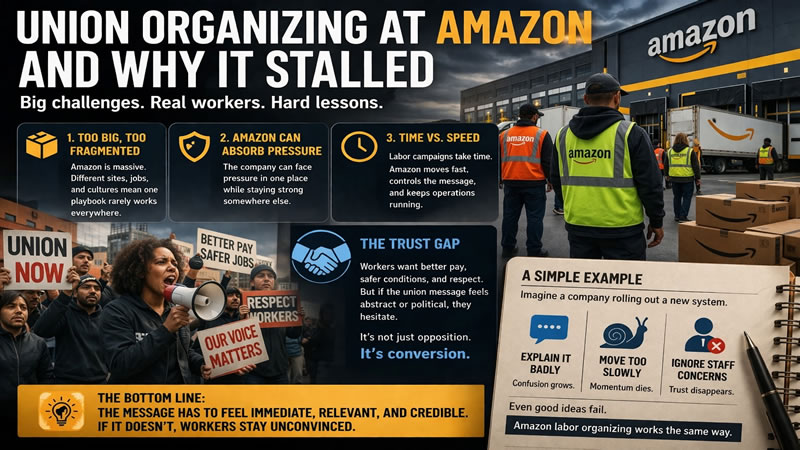
A business example makes this easier to see. Imagine a local company trying to roll out a new employee system. If leaders explain it badly, move too slowly, or ignore staff concerns, the rollout fails even if the idea is good. Amazon labor organizing works the same way. The message has to feel immediate, relevant, and credible. If it does not, workers stay unconvinced. That is an inference from the voting and bargaining pattern, not a claim that every campaign lacked effort.
The reason this story is still hot in 2026 is that it never really ended. Reuters reported in April 2026 that the NLRB said Amazon must negotiate with Staten Island warehouse workers, and the ruling said Amazon had engaged in unfair labor practices by refusing to bargain. That is not old history. That is a live labor fight.
Amazon is also still dealing with wider company pressure. Reuters reported in January 2026 that the company was planning thousands more corporate job cuts as part of a broader goal to trim roughly 30,000 corporate roles. Reuters also noted that Amazon had tied earlier cuts to the rise of artificial intelligence. That matters because labor campaigns do not happen in a vacuum. Job insecurity, restructuring, and tech-driven change all affect how workers think about bargaining and risk.
That is why creamed by Amazon is still a useful phrase in 2026. It captures the feeling that organizers are not just facing one employer. They are facing a moving target shaped by legal battles, restructuring, platform power, and public perception.
If you are writing about this topic, start with one clean thesis: Amazon labor organizing is hard because scale, timing, and worker trust all have to line up at once. Then build the article around three proof points: the Staten Island bargaining order, the North Carolina rejection, and the Teamsters affiliation. Those three facts alone give the piece structure and momentum.
Next, explain the organizer’s side without sounding naive. The strongest content does not pretend that labor campaigns are easy. It shows why the campaign may have been smart in some places and weak in others. That is where creamed by Amazon becomes a strong keyword and a strong idea. It gives you a dramatic hook, but the article must still deliver a real explanation underneath it.
A practical test you can run before publishing is this: remove every paragraph that does not help answer “why did organizers lose?” If it does not support that answer, cut it. That will keep the article tight, readable, and rankable.
This trend is growing because Amazon remains one of the most visible labor battlegrounds in the USA. The 2026 NLRB bargaining order kept Staten Island in the news, and fresh Reuters coverage of layoffs and AI-related restructuring shows that Amazon is still changing fast. When a company this big keeps moving, labor strategy has to keep adapting too.
It is also growing because labor organizing now sits inside a wider conversation about worker power, corporate scale, and technology. Teamsters backing the Amazon Labor Union showed that organizers are trying to build broader coalitions, not just isolated campaigns. That makes creamed by Amazon a phrase with ongoing traffic potential because it points to a continuing fight, not a dead story.
The reason organizers think they got creamed by Amazon is not mysterious. They were dealing with a company that can resist pressure for a long time, keep control of the worker relationship, and shift the battlefield whenever needed. Yet the story is not just about defeat. It is also about persistence. Staten Island won in 2022, the Teamsters affiliation in 2024 showed the campaign was still alive, and the 2026 NLRB ruling proved that Amazon’s labor conflict is still active.
That is the real takeaway. ” Creamed by Amazon is not just a harsh phrase. It is a warning label for any campaign that underestimates scale, timing, and worker trust. If organizers want a different outcome, they need stronger local messaging, better conversion from interest to votes, and a longer-term plan that can survive Amazon’s pushback. The story is still unfolding, and that is exactly why it keeps drawing attention in 2026.
1) What does “creamed by Amazon” mean in this context?
It is a blunt way of saying organizers felt outmatched by Amazon’s strategy and scale.
The phrase points to campaign pressure, vote losses, and bargaining roadblocks.
2) Why did Amazon union organizers struggle?
They faced a company that prefers direct worker relationships and has resisted union recognition.
They also had to win across different warehouses with different local dynamics.
3) Did the Amazon Labor Union ever win?
Yes. Workers at Staten Island’s JFK8 voted to join the union in 2022.
Reuters later reported the ALU aligned with the Teamsters in 2024.
4) Why is the Amazon labor story still trending in 2026?
Because the NLRB ruled in April 2026 that Amazon must bargain with Staten Island workers.
At the same time, Reuters reported new corporate layoffs and restructuring.
5) Is creamed by Amazon a good SEO keyword?
Yes, because it is specific and tied to a focused labor story.
It is much easier to target than broad terms like “Amazon labor” or “union news.”